


Last Updated: October 23, 2026
Quick Summary
A leather harness fitting is a made-to-measure process built around your own body rather than a size chart, so straps sit correctly and buckles land clear of pressure points. Take five readings, chest, underbust, shoulder width, torso length and strap path, and check each twice before sending them to your maker.
- Gather a soft tailor's tape, a mirror or helper, a notebook and a close-fitting top before measuring.
- Measure at the end of the day, as an evening reading is usually closer to how you will wear the piece.
- Keep the tape snug enough to slide one finger under it, and never round down to force a fit.
- If you are between sizes, go up and use the adjustable buckles to take in the slack.
- A harness should stay put through a full night yet let you slide one finger under every strap.
Table of Contents
- Why a Bespoke Leather Harness Fits Differently
- What You'll Need Before You Measure
- How to Measure for a Leather Harness
- Leather Harness Sizing Guide: Reading Your Numbers
- Men's Leather Body Harness Fit: How Tight Is Right
- Common Fitting Problems and How to Fix Them
- What to Wear and What to Expect at a Fitting
- Frequently Asked Questions
Why a Bespoke Leather Harness Fits Differently
A leather harness fitting is a made-to-measure process built around your own body, not a size chart. That difference shows up the moment you put it on: straps sit where they should, buckles land clear of pressure points, and the whole thing moves with you instead of against you.
This guide from Spitfire Leather walks through the full bespoke leather harness fitting guide process, from the tape measure to the final adjustment. We have been making leather gear since 2010. Below, we show you exactly how to avoid common fitting mistakes.
Off-the-peg harnesses are cut to a handful of sizes and expected to suit everyone in that band. They rarely do. Body shape varies far more than chest size alone suggests.
Bespoke work starts from your numbers. A good maker reads those numbers and builds to that. You can see what a finished bespoke piece looks like on our Warrior Harness page, which is hand-made from 3mm thick leather with adjustable buckles.

Here is the core point most fitting advice misses: a harness is a load-bearing garment. It carries tension across the chest, shoulders and back. Get the geometry wrong and no amount of tightening will fix it.
What You'll Need Before You Measure
Before you measure for a leather harness, gather four things: a soft tailor's tape, a mirror or a second pair of eyes, a notebook, and a plain, close-fitting top. Measuring over baggy clothing is the fastest way to order the wrong size.
Here is the full kit:
- A soft fabric tape measure, not a metal builder's tape
- A mirror, or someone to help with back and shoulder readings
- A pen and paper, or your phone's notes app
- A light top you can measure over, or bare skin
- Your current harness, if you have one, for comparison
Two small habits make a big difference. Stand naturally rather than puffing your chest out. And take every measurement twice, then use the average if the two readings differ.
How to Measure for a Leather Harness
To measure for a leather harness, take five readings: chest at the fullest point, underbust, shoulder width, torso length and strap path. Write each one down in centimetres and check each reading twice before you send them.
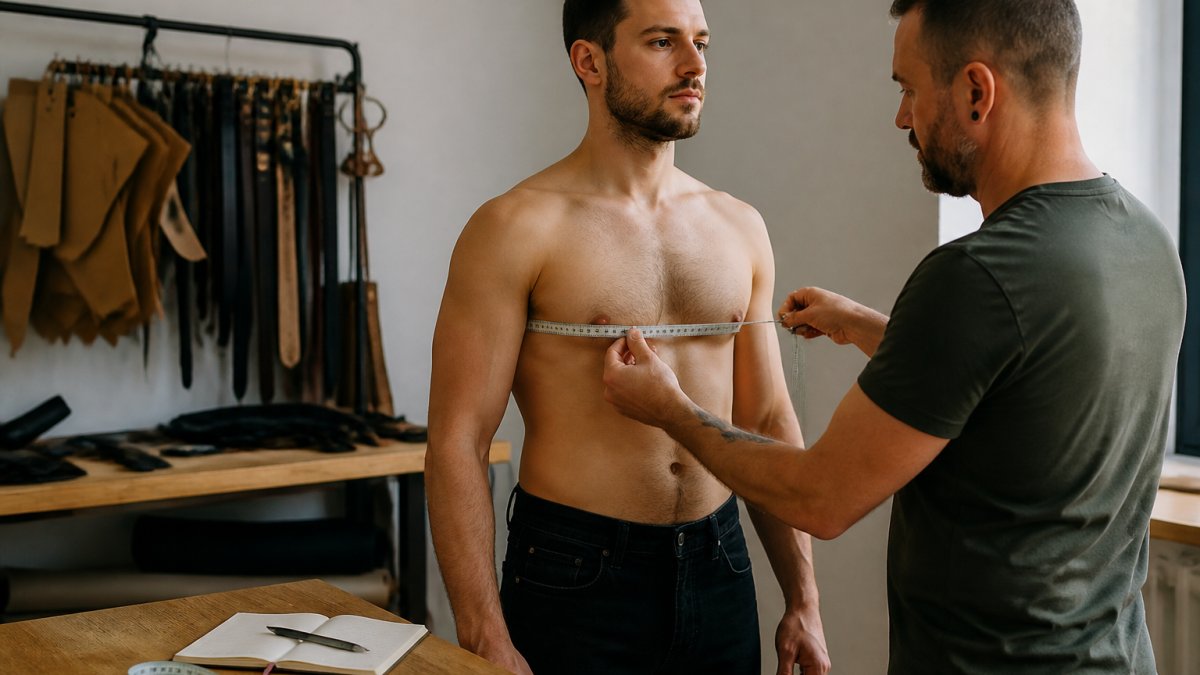
Keep the tape snug but not tight. You should be able to slide one finger under it. If the tape digs in, the reading is too small.
Chest, Underbust and Shoulder Measurements
Chest is the fullest part of your chest, tape level under the arms and across the shoulder blades. Breathe out normally and read the number.
Underbust sits just below the chest muscle, around the ribcage. This reading controls where the lower strap sits.
Shoulder width runs from the bony point of one shoulder, across the back of the neck, to the matching point on the other side. Do not measure straight across the front.
For a men's leather body harness fit, these three numbers do most of the work. Get them right and the rest of the fitting falls into place.
Torso Length and Strap Path
Torso length runs from the hollow at the base of your throat down to your natural waist. This tells the maker how far the harness should extend.
Strap path is the route the straps take across your body. Photograph yourself in a simple harness, or sketch the lines on a photo. Mark where you want straps to cross and where you want them to sit clear.
Leather Harness Sizing Guide: Reading Your Numbers
Reading your numbers means matching each measurement to the maker's size band, then checking the strap path against your own frame. Never round down to force a fit, and never assume you are the same size across two different makers.
Sizing conventions vary between workshops, so a size that fits from one maker may not fit from another.
Use this checklist when you compare your numbers to a size chart:
- Chest reading matches the band, not the band below it
- Underbust sits inside the stated range, not at the very edge
- Shoulder width allows the straps to sit on the shoulder, not the neck
- Torso length puts the lower strap where you actually want it
- Adjustable buckles give you room to move either way
If you are between sizes, go up and use the buckles. Adjustable hardware is there for exactly this reason.
Want to see how a set of measurements translates into a real harness? Our Spitfire Elastic Harness page shows a lighter, non-leather option with the same measuring logic behind it.

Men's Leather Body Harness Fit: How Tight Is Right
A men's leather body harness should sit snug enough to stay put through a full night of movement, and loose enough that you can slide one finger under every strap. If a strap leaves a deep mark or restricts your breathing, it is too tight.
Fit is not one setting. It changes across the body:
- Chest straps: snug, flat against the body, no digging
- Shoulder straps: firm but never pressing on the neck
- Back straps: the tightest point, since this is where the load sits
- Lower strap: the loosest, so you can bend and sit freely
Adjust in small steps. Tighten one strap, move around, then adjust the next. Do this in front of a mirror so you can see how the straps sit from the side and back.
For a reference point on how a properly fitted men's harness should sit, view the Spitfire Elastic Harness product page and note where the straps land on the model.

Common Fitting Problems and How to Fix Them
Most fitting problems come down to four causes: a measurement taken over clothing, a strap path that fights your body, hardware sitting on a pressure point, or a size chosen to match a number rather than a fit.
| Problem | Likely Cause | Fix |
|---|---|---|
| Straps dig into the shoulders | Shoulder width measured too narrow | Re-measure across the back of the neck |
| Harness rides up at the back | Torso length too short | Add length or adjust the lower strap |
| Chest straps gape when you move | Chest measured over clothing | Re-measure on bare skin or a light top |
| Buckles press on the ribs | Strap path crosses a pressure point | Shift the strap line up or down |
| Chafing after an hour | Over-tightened to stop slipping | Loosen and correct the strap path |
If you have had made-to-measure leather that was still tight in the wrong places, send photos with your numbers and the maker can build around your actual shape.
What to Wear and What to Expect at a Fitting
Wear a plain, close-fitting top and trousers you would actually wear with the harness. Bring your measurements, any reference photos, and your event dates. A fitting usually involves trying the piece, adjusting the straps, and confirming the final numbers.
Expect the fitting to focus on movement, not just standing still. You will be asked to raise your arms, bend, and turn.
Bring these with you:
- Your written measurements, in centimetres
- Photos of the strap path you want
- The trousers or boots you plan to wear with it
- Your event date, so timing can be planned
Spitfire Leather runs limited bespoke and made-to-measure work alongside off-the-peg pieces, with new collections launched every few months.
Getting a harness to fit properly is not about tightening it until it stops moving. It is about measuring honestly, mapping the strap path, and adjusting in small steps until the piece works with your body.
At Spitfire Leather, we build limited-edition leather couture and made-to-measure pieces for clubbers, performers and enthusiasts who want something genuinely their own. Our gear is worn by fans of BLUF and Tom of Finland, and by contestants at International Men of Leather and Mid Atlantic Leather. Every piece is hand-assembled from quality leather, with adjustable buckles built in so you can fine-tune the fit as your body changes.
Get started with Spitfire Leather and commission a harness measured to your own body, not a size chart.
Frequently Asked Questions
How tight should a leather harness fit?
Snug enough that the straps stay flat against the skin and the harness does not shift when you raise your arms, but loose enough to slide a flat finger under each strap. A leather harness fitting that leaves red pressure lines after ten minutes is too tight. Remember that 3mm leather has almost no give, so the measurement you send is the fit you get. Adjustable buckles, as on the Warrior Harness, let you fine-tune by a few centimetres either way.
Where should a leather harness sit on the body?
The chest strap crosses the pectorals roughly level with the nipple line, the underbust strap sits at the base of the ribcage, and the shoulder straps run over the collarbone without cutting into the neck. Check the position in a mirror with your arms raised before you commit to measurements.
Can a bespoke leather harness be adjusted after it is made?
Some adjustment is possible. Harnesses with adjustable buckles, such as the Warrior Harness, can be made bigger or smaller to suit changes in body mass. Adding new holes is straightforward, but shortening straps permanently alters the design, and letting out a harness only works if the original build left spare length. Send your measurements with a little breathing room rather than sizing down, and raise any planned body changes with the maker before the piece is cut.
How do you care for a leather harness after wearing it?
Wipe the straps with a barely damp cloth after wear to remove sweat and body oils, then let the harness air dry flat, away from radiators and direct sun. Condition the leather two or three times a year with a dedicated leather conditioner, working it in thinly. Store it hung or rolled loosely rather than folded. Check buckles and stitching before each event so a loose rivet never becomes a mid-show problem.


