


Table of Contents
- Why Is Handmade Leather More Expensive? The Short Answer
- Handmade vs Mass-Produced Leather: What Actually Changes
- The Hours Behind Every Garment: Time and Labour in Handmade Leather
- Bespoke Leather Clothing: Paying for Fit, Not Just Fabric
- Made-to-Measure Leather Garments: What Drives the Price
- Durability and Longevity: Why Handmade Leather Outlasts Cheap Alternatives
- Limited Editions and Scarcity: The Real Cost of Exclusivity
- Conclusion: When Handmade Leather Is Worth the Price
- Frequently Asked Questions
Last Updated: October 8, 2026
Why Is Handmade Leather More Expensive? The Short Answer
Handmade leather is more expensive because the price reflects the hide, the hours and the skill that go into a single garment, not the volume of an assembly line. At Spitfire Leather, we have been making limited-edition leather couture since 2010, and the cost gap comes down to three things: better raw material, slower construction and far fewer units.
Most guides treat "handmade leather" as one category. It is not. The difference between a cheap mass-produced piece and a handmade one is not just a label, it is a different set of decisions at every stage of production. Below, we break down exactly where the money goes, and why a jacket that costs more up front often costs less per year of wear.
Handmade vs Mass-Produced Leather: What Actually Changes
Handmade and mass-produced leather differ in two measurable ways: the grade of hide used and how the seams are joined. Both affect how the garment feels on day one and how it looks after five years of clubbing, performing and travel.
Hide quality: full-grain aniline versus corrected grain
The hide is the single biggest cost variable. Full-grain aniline leather keeps the natural surface of the animal, so every piece carries its own grain, marks and character. Corrected grain hides are sanded and coated to produce a uniform finish, which hides flaws and lets factories accept cheaper, lower-grade skins.
Our Black Shirt and BLUF® Shirt are both cut from 100% aniline full-grain leather. That material choice alone pushes the cost up, because you cannot hide a flaw in an aniline finish. You reject the hide instead.

Construction: hand-stitched seams versus assembly-line gluing
Mass production optimises for speed. Panels are cut in stacks, glued, then run through a machine in seconds. Handmade construction does the opposite: panels are cut individually, seams are stitched and reinforced by hand, and hardware is set piece by piece.
The BLUF® Jacket with Quilting is a fair example. It uses hand stitching, YKK zips, DuPont Kevlar insets at the elbow and shoulder, and removable CE protectors. None of that is fast to assemble. That is precisely the point.
The Hours Behind Every Garment: Time and Labour in Handmade Leather
Labour is where the price gap widens fastest. A factory line can turn out hundreds of identical shirts in a day. A handmade garment moves at the pace of one person's hands, and those hands are paid for their skill, not their speed.
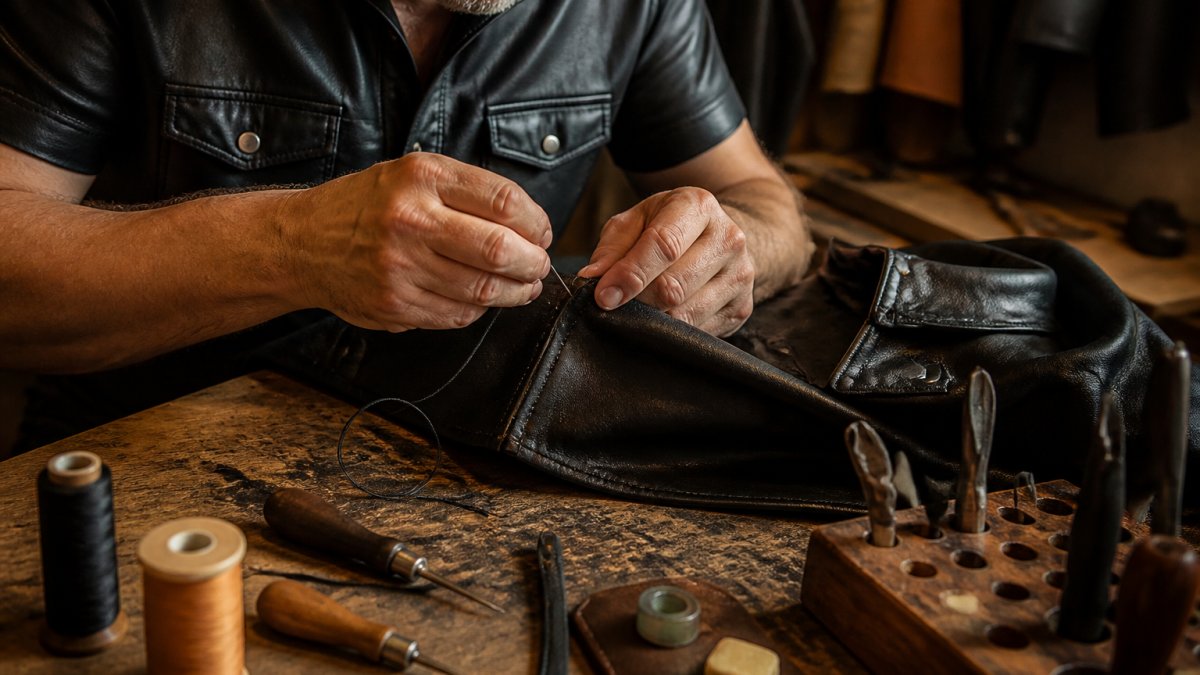
Cutting a single shirt from an aniline hide takes care, because the cutter has to work around natural marks and match the grain across panels. Stitching the seams, setting press studs, lining the body and finishing the edges all add time. A common mistake buyers make is assuming "handmade" only refers to the final stitching. In practice, it covers every stage, and every stage is slower by design.
Bespoke Leather Clothing: Paying for Fit, Not Just Fabric
Bespoke leather clothing is a garment drafted from your own measurements and built as a single piece, rather than a standard size pulled off a rack. That process adds cost before a single stitch is sewn, because nothing is shared with another customer's order.
Off-the-peg has its place. Our Box Kilt and Black Shirt are ready to order and sized to a chart, which keeps them accessible. Bespoke is different: it exists for people who need a garment that fits a specific body and a specific look, and who are willing to wait for it.

The trade-off is straightforward. You pay more and you wait longer, and in return you get something that cannot be bought off a shelf by anyone else.
Made-to-Measure Leather Garments: What Drives the Price
Made-to-measure leather garments cost more because the pattern is drafted for one body, the hide is cut for one garment, and the fit is refined through fittings. Three cost centres sit behind that.
Measurement sessions and toile fittings
A fitting session takes a maker's time and cannot be batched. Measurements are taken, checked and often re-checked, because leather does not forgive a miscalculation the way a loose fabric might. If a toile or mock-up is used, that is additional material and additional hours before the final hide is ever cut.
Pattern drafting and single-piece cutting
A standard size pattern is reused thousands of times. A bespoke pattern is drafted once, for one customer, then used once. The cutter then lays that pattern on a single hide and works around its natural grain and marks, which means more hide is consumed per garment than a factory would tolerate.
Durability and Longevity: Why Handmade Leather Outlasts Cheap Alternatives
Handmade leather usually outlasts cheap alternatives because the seams, hardware and hide are all built to survive repeated wear, not to hit a price point. The cost per year of ownership often ends up lower than the sticker price suggests.
Consider what fails first on cheap leather gear. It is rarely the hide. It is the glued seams that separate, the thin hardware that snaps, or the corrected-grain coating that cracks and peels where the garment flexes. None of those failures are repairable in any meaningful way.
Better construction changes the maths. Double-stitched seams, quality zips and full-grain hides can be cleaned, conditioned and worn for years. A garment that lasts three times as long at twice the price is the cheaper purchase, and it looks better while it does it.
| What you are comparing | Mass-produced leather | Handmade leather |
|---|---|---|
| Hide grade | Corrected grain, coated | Full-grain aniline |
| Seam construction | Glued, machine-run | Hand-stitched, reinforced |
| Hardware | Thin, generic | YKK zips and press studs |
| Fit | Standard block sizes | Off-the-peg or drafted to measure |
| Lifespan | Fails at seams and coating | Ages and can be maintained |
If you are coming from cheaper fetish gear, expect the first difference to be weight and stiffness. Full-grain aniline starts firmer and softens into the shape of the wearer over the first months.
Limited Editions and Scarcity: The Real Cost of Exclusivity
Limited editions cost more because the run is short. Setup time, pattern development and material sourcing are spread across a small number of garments instead of thousands, so each unit carries a larger share of the fixed cost.
Scarcity is not a marketing trick in this model, it is arithmetic. A design made in a run of twenty cannot absorb its development cost the way a design made in a run of two thousand can. That is why limited leather couture sits at a higher price, and why it stays rare.
At Spitfire Leather we launch new collections every few months and retire the old ones. A piece you buy from a run is genuinely the end of that run, not a pause before the next batch.
Conclusion: When Handmade Leather Is Worth the Price
The honest answer is that handmade leather is worth the price when you intend to wear the garment hard and keep it. If you want something for one night, the maths does not work. If you want a piece that fits you, survives the club and still looks right in five years, the cheaper option is usually the more expensive one.
That is the case Spitfire Leather builds for: limited-edition leather couture, cut from full-grain aniline hides, hand-constructed and available off-the-peg or made to measure. Our Black Shirt, BLUF® Shirt and Box Kilt are ready to order now, with new runs released every few months and old ones retired for good.
Frequently Asked Questions
Why does handmade leather cost more than mass-produced leather?
Handmade leather costs more because each piece uses full-grain aniline hides rather than corrected-grain leather, and a single craftsman cuts, stitches and finishes the garment by hand. That process takes hours of skilled labour instead of minutes on a production line. Mass-produced items also use thinner leather, glued seams and simplified patterns to keep unit costs down. The higher price reflects better materials, slower construction and a garment that will not fall apart after a few wears.
Does handmade leather last longer than factory-made leather?
Generally, yes. Handmade leather garments use full-grain hides and hand-stitched seams that resist splitting, while mass-produced alternatives often rely on thinner leather and glued or lightly stitched joins. Full-grain aniline leather develops a patina over time and can be conditioned to stay supple. Factory-made leather may use corrected-grain or bonded leather that cracks or peels. With basic care, a handmade piece can last years longer, which spreads the cost over far more wears.
Is bespoke leather clothing more expensive than off-the-peg?
Bespoke leather clothing costs more than off-the-peg because it involves individual measurements, a dedicated pattern and fittings before the final garment is cut. Off-the-peg items are made to standard sizes in bulk, so the cost per unit is lower. With bespoke, you pay for the time of a pattern cutter and maker, plus the risk of cutting a one-off hide. The result is a garment that fits your body exactly, which standard sizing rarely achieves.
How can you tell whether handmade leather is worth the price?
Look at the hide, the seams and the fit. Full-grain aniline leather has a natural surface with visible pores and slight variations in tone; corrected grain looks uniform and plastic-like. Hand-stitched seams are even and tight, often with a slight saddle-stitch angle. Check whether the maker offers made-to-measure options and can explain where the leather comes from. If the garment fits well, uses quality hides and shows careful construction, the higher price reflects real value rather than a label.
Most leather buyers eventually face the same choice: replace a cheap piece every couple of years, or commission one that fits properly and lasts. Spitfire Leather makes limited-edition leather couture from full-grain aniline hides, hand-constructed with double-stitched seams and quality hardware, and offers both off-the-peg sizing and bespoke made-to-measure options. Get started with Spitfire Leather and own a garment that is genuinely yours.


